SADC Certified Exporter
Nationwide & Cross-Border Delivery
Contact us for an Obligation Free Quote
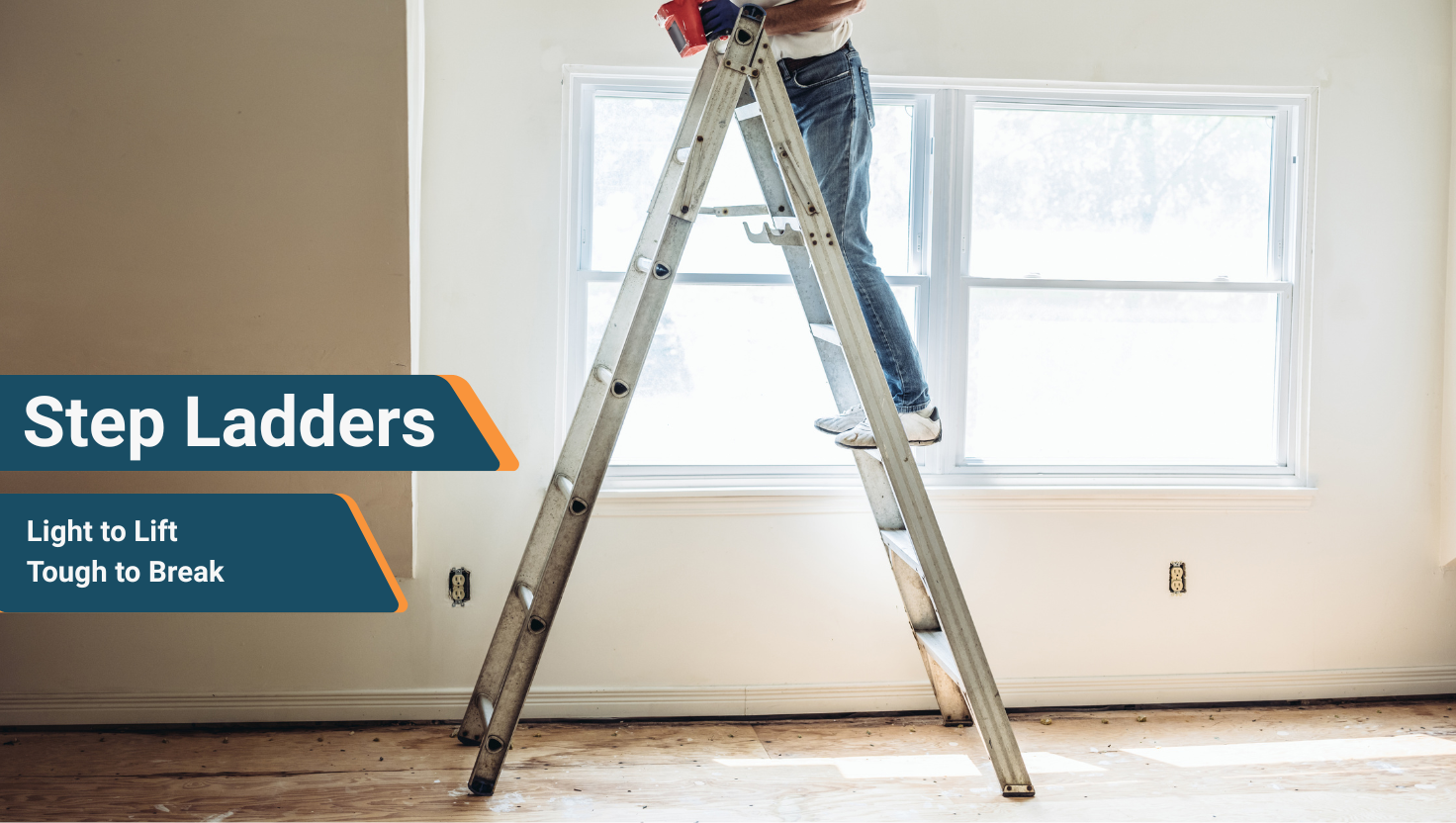
Dreymar Industrial supplies A-frame step ladders in aluminium and fibreglass, from 3 steps to 16 steps, covering ladder heights of 0.8 m to 4.8 m. Choose by working height, not ladder height: the height of the ladder itself is not the height you can safely reach.
Working height is roughly the ladder height plus 1.0 m to 1.2 m, because you can reach overhead while standing two steps down from the top. Use the table below to work backwards from the height of your task.
| Steps | Ladder height | Working height | Typical task |
|---|---|---|---|
| 3 | 0.78 m to 0.9 m | 1.9 m to 2.1 m | Shelf picking, light fittings, signage |
| 4 | 1.2 m | 2.2 m to 2.4 m | Standard ceiling height, office maintenance |
| 5 | 1.3 m | 2.3 m to 2.5 m | Stockroom shelving |
| 6 | 1.8 m | 2.8 m to 3.0 m | Warehouse racking level 2, ducting |
| 7 | 1.8 m | 2.8 m to 3.0 m | As above, extra steps for comfort |
| 8 | 2.4 m | 3.4 m to 3.6 m | High-bay lighting, upper racking |
| 9 | 2.4 m | 3.4 m to 3.6 m | As above, double sided access |
| 10 | 3.0 m | 4.0 m to 4.2 m | Plant maintenance, overhead lines |
| 12 | 3.6 m | 4.6 m to 4.8 m | Industrial ceilings, gantry access |
| 14 | 4.2 m | 5.2 m to 5.4 m | High-bay warehouse, structural work |
| 16 | 4.8 m | 5.8 m to 6.0 m | Maximum reach in the A-frame range |
Not every model offers every step count. The heavy duty aluminium A-frame step ladder carries the widest range, from 3 steps through to 16. The medium duty aluminium A-frame runs 3 to 12 steps. Domestic models stop at 7 or 9 steps.
Worked example: a light fitting at 3.5 m. Subtract 1.1 m of reach, leaving 2.4 m. That is an 8-step ladder.
Material is decided by the working environment, not by height. Both are available across most of the step range.
Choose aluminium step ladders where weight and portability matter. They are lighter to carry between tasks, corrosion resistant, and the standard choice for warehousing, general maintenance and stock picking.
Choose fibreglass step ladders where there is any chance of contact with live electrical parts. Fibreglass is non-conductive, which means the ladder does not become part of the circuit if a tool or hand contacts a live conductor. This is the correct specification for electricians, instrument technicians and anyone working near switchgear or distribution boards.
Double sided step ladders allow climbing from either side, which suits busy sites where two people need access or where the ladder cannot be turned in a confined aisle.
Safe Working Load (SWL) is the total the ladder is rated to carry, and that total includes the user, clothing and PPE, hand tools, and anything being carried up. A technician at 85 kg with a loaded toolbelt and a replacement fitting can be closer to 110 kg than 85 kg.
SWL varies by model across the Dreymar step ladder range. Check the rating on the individual product page before ordering, particularly where a ladder is shared between departments and will carry the heaviest user rather than the average one.
Step ladders are self-supporting and suit open-floor tasks. They are not always the right answer.
Height and material cover most of the decision, but the working environment sets the rest of the specification. Five sectors account for most industrial step ladder demand in South Africa, and each pushes the choice in a different direction.
Two specification points get overlooked in every sector. Folded dimensions decide whether the ladder actually gets used or stays racked, so measure your storage bay and vehicle before choosing a height. Replaceable feet and locking spreaders determine service life, because worn feet on a smooth warehouse floor are the most common cause of a ladder being retired early.
Dreymar Industrial delivers nationwide from Germiston, Gauteng, with cross-border shipping across Southern Africa as a SADC Certified Exporter. Step ladders sit within the full ladder range, alongside single, extension, combination and mobile safety models.
Local conditions change the specification more than buyers expect. Coastal humidity and salt air shorten the service life of untreated fittings, so hinges, spreaders and rivets deserve closer attention at inspection on sites in Durban, Cape Town and Gqeberha.
The same applies in East London, where coastal warehousing and assembly work put ladders through daily handling in humid air. Inland the problem inverts: Highveld dust works into hinges and locking mechanisms on sites across Johannesburg and Pretoria, where the fix is regular cleaning rather than corrosion protection.
Central and regional operations in Bloemfontein, Polokwane and Mbombela tend to run mixed fleets across logistics, agriculture, healthcare and mining support, where one ladder covers several task types and the taller duty classes see more use.
Take the height of your task and subtract 1.0 m to 1.2 m for overhead reach. The remainder is your ladder height. For a task at 3.5 m, that gives 2.4 m, which is an 8-step ladder. If your figure falls between sizes, choose the taller ladder.
Ladder height is the physical height of the ladder. Working height is how high you can safely reach while standing two steps down from the top, roughly ladder height plus 1.0 m to 1.2 m. Always specify against working height.
A 6-step A-frame ladder stands 1.8 m tall, giving a working height of approximately 2.8 m to 3.0 m. That suits warehouse racking at the second level, ducting, and most industrial ceiling work in standard-height buildings.
The tallest A-frame in the Dreymar range is a 16-step ladder at 4.8 m, giving a working height of approximately 5.8 m to 6.0 m. Above that height, an extension ladder or a mobile safety ladder with a platform is usually the safer option.
Choose fibreglass wherever live electrical work is possible, because fibreglass is non-conductive. Choose aluminium everywhere else, since it is lighter to move between tasks and resists corrosion. Both are available across most step counts in the range.
The top step and the top cap are not designed as standing platforms. Standing there raises your centre of gravity above the ladder's stable base and removes handhold options. If you need that height, the ladder is too short for the task.
A step ladder is a self-supporting ladder with flat steps and a hinged design, allowing safe and stable access to elevated areas without needing wall support.
We supply a range of step ladders, including aluminium, fibreglass, and heavy-duty steel options for industrial, commercial, and domestic use.
Yes, our step ladders are built to withstand heavy-duty use in warehouses, factories, workshops, and construction sites.
Depending on the model, our step ladders support different load ratings. Heavy-duty models can hold up to 150 kg or more.
Yes, all step ladders are compliant with South African safety standards for durability, stability, and slip resistance.
Yes, all our step ladders are designed to fold compactly for convenient transport and storage.
Absolutely. In addition to industrial models, we also offer lightweight step ladders suitable for household tasks.
Yes, simply browse our Step Ladder range and use the Add to Quote function. Once submitted, a Dreymar consultant will contact you with a tailored quotation and delivery details.
Yes, some models include integrated handrails for additional safety, especially for frequent or prolonged use.
Yes, we provide nationwide delivery with reliable logistics partners for fast, secure shipping.
We offer step ladders made from aluminium for lightweight handling, fibreglass for electrical safety, and steel for maximum strength.
Fibreglass step ladders are non-conductive, making them ideal for electrical applications.
Yes, we can fulfil bulk orders for contractors, factories, and warehouses with competitive project-based pricing.
Yes, replacement feet, hinges, and other components are available to maintain ladder safety and functionality.
We combine high-quality materials, safety compliance, customisable options, and expert advice to deliver step ladders that meet both professional and domestic needs.
